
SAINT REGULUS, CROMARTY
Saint Regulus’ Church began as a Mission from Fortrose in 1877 under the dedication of ‘All Saints’, with the people meeting for worship in the County Buildings.
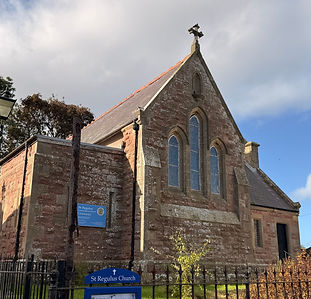
The foundation stone of the church was laid in 1904 and the building completed in 1906. The new Gothic church was dedicated ‘All Saints’. Some time later the dedication was changed to ‘St Regulus and All Saints’, then to ‘St Regulus’ alone, as a condition for receiving a generous legacy!
In the sanctuary is a fine stone altar against the east wall, traditionally furnished with a cross and six candlesticks. Although a freestanding altar is used for the Eucharist on most Sundays, the high altar remains an intimate and prayerful setting for smaller celebrations.
Above the high altar is the beautiful east window, with the Resurrection of Our Lord at the centre, the Nativity to the left, and the Baptism of Christ to the right.

The congregation is seated in a circle around the lectern for the Liturgy of the Word, giving visible expression to the Church gathered around the Scriptures; from there the liturgy turns naturally towards the altar and the celebration of the Eucharist.


There are memorial windows by Sir Ninian Comper: on the north wall of the Risen Lord with his followers (in memory of the Rev Albert Chadwick – depicted kneeling in one of the windows – Priest-in-Charge before St Regulus’ was joined with Fortrose); the other is of St Francis of Assisi with locally-found animals – a fox, a lamb, a rabbit and a cairn terrier at his feet.
Comper’s famous ‘signature’, a strawberry, can be seen in the corner of each of these windows.


THE LADY CHAPEL
Through the Archway to the right of the high altar is in what would have been the base of the tower, had finances been available to build it, you will find a small but beautiful chapel dedicated to the Mother of God It is adorned with four narrow windows depicting the four seasons.
A tabernacle or Sacrament House on the centre of the chapel’s altar houses our Lord’s Presence in the Blessed Sacrament.
This area is set asside especially for prayer and contemplation.

WHO WAS ST REGULUS?
Not much is known about Saint Regulus’ life, and there are several versions of the story. Saint Regulus was a monk or bishop of the city of Patras, in present-day Greece, then part of the Roman Empire. In AD 345 Regulus was told by an angel in a visionary dream that the Emperor Constantine had decided to remove Saint Andrew’s relics from Patras to Constantinople, and in some retellings that Constantine was about to invade Patras. For safekeeping Regulus was to move as many bones as far away as he could to the western ends of the earth, where he should found a church dedicated to St Andrew. He was accompanied on his voyage by a number of consecrated virgins, among these Saint Triduana.
According to the various accounts Regulus was either shipwrecked or told by an angel to stop intentionally on the shores of Fife at the spot called Kilrymont, a Pictish settlement which is now St. Andrews. Here he was welcomed by a Pictish king, Óengus I.
It is claimed that St Regulus brought the relics of Saint Andrew to Scotland. (three fingers of the saint’s right hand, the upper bone of an arm, one kneecap, and one of his teeth.)

SERVICES @ ST REGULUS
SUNDAY
9.30am HOLY EUCHARIST
WEDNESDAY
9.00am Celtic Morning Prayer (Via Zoom)
FRIDAY
11.00am HOLY EUCHARIST
5.00pm Silent Prayer
The Church is open most days for prayer and contemplation